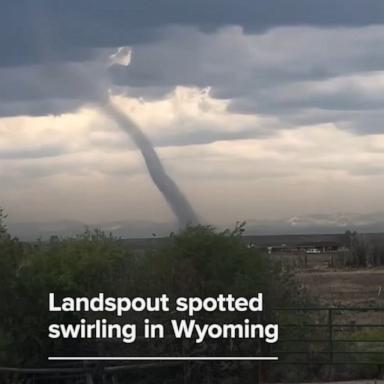
When a local sheriff in Wyoming pointed his camera at a massive, spinning column of dirt and air swirling through an open field, the video went viral almost instantly. Mainstream news outlets splashed it across their homepages with flashy headlines. Most people saw the footage and thought they were looking at a classic tornado ripping through the high plains.
They weren't. What they saw was a landspout.
While a landspout looks like a traditional tornado, it functions completely differently under the hood. If you think the distinction is just nerdy meteorological semantics, you're wrong. Understanding how these twisters form, why Wyoming gets so many of them during the summer, and what makes them genuinely dangerous is vital for anyone living in the Rocky Mountain West.
The Secret Mechanics of a Landspout
To understand why a landspout isn't a typical tornado, you have to look at where the spinning starts.
A classic, destructive tornado forms from the top down. It requires a supercell thunderstorm, which is a massive storm system that already possesses an organized, rotating updraft called a mesocyclone. The storm's internal rotation spins faster and tighter, eventually stretching downward until a funnel cloud makes contact with the ground.
Landspouts flip that script completely. They build from the ground up.
Imagine a hot summer afternoon in Wyoming. The sun bakes the high-altitude dirt, creating small, localized areas of spinning air near the surface, very similar to a common dust devil. At the same time, a relatively weak, growing thunderstorm moves overhead. If the updraft of that developing storm happens to pass directly over that pre-existing ground circulation, it acts like a giant vacuum cleaner. The upward suction stretches the spinning air vertically, pulling it up toward the cloud base.
Because they don't rely on massive, rotating supercells, landspouts can form under seemingly innocent clouds. You don't need a massive, dark green sky or a multi-state storm system to get a landspout. You just need a little bit of surface spin and a healthy updraft.
Why Wyoming is a Magnet for Ground-Up Twisters
Meteorologists like Don Day have long pointed out that the atmospheric setup of the Rocky Mountain West creates a perfect breeding ground for landspouts. The terrain itself plays a major role. Wyoming's vast plains, high elevations, and sudden mountain ranges create sharp boundaries where winds collide. These colliding winds generate plenty of small, localized ground rotations.
When summer thunderstorms pull moisture into the region, the atmosphere gets highly unstable. The temperature difference between the baking ground and the cool upper air fuels intense updrafts.
We've seen multiple instances of this across the state recently. In early June, public spotters and emergency managers confirmed landspouts near Horse Creek and southeast of Wright, Wyoming. Later in the month, residents in Sublette County witnessed a well-formed landspout swirling near Big Piney, triggered by a sudden surge of atmospheric moisture.
Social media makes it seem like these events are skyrocketing out of control. Honestly, the real shift is just that everyone carries a high-definition camera in their pocket now. Professional storm chasers and local residents capture these events instantly, giving landspouts a massive digital footprint that didn't exist two decades ago.
The Real Danger Most People Ignore
Because landspouts don't come from massive supercell storms, people tend to treat them like harmless tourist attractions. That's a dangerous mistake.
A landspout won't carry the apocalyptic, multi-mile-wide destructive force of an EF5 tornado, but it can easily pack wind speeds between 70 and 90 mph. That's equivalent to an EF0 or EF1 tornado on the Enhanced Fujita scale. Winds of that velocity are more than strong enough to flip mobile homes, rip shingles off roofs, uproot trees, and snap utility poles. The Sublette County event, for instance, combined with surrounding winds to trigger more than 700 power outages in the area.
Another hidden hazard is how hard they are to predict. Traditional weather radar looks for rotation high up in the belly of a thunderstorm. Because landspouts start at the ground and lack a large mesocyclone, they rarely trigger traditional radar-based tornado warnings until they are already fully formed and visible to the naked eye. You won't always get a fifteen-minute head start on your phone.
What You Should Do When One Appears
If you live in or travel through Wyoming during the stormy season, you need a practical plan for these sudden atmospheric spin-ups.
Do not park your car on the side of the highway to take a video for social media. Landspouts can change direction erratically based on minor shifts in the local wind patterns. If you spot a swirling column of dust connecting a field to a cloud base, treat it exactly like a regular tornado.
Move indoors immediately. Find a sturdy building and put as many walls between yourself and the outside as possible. Avoid mobile homes, vehicles, and open structures like barns or picnic shelters. If you're caught in the open plains with no shelter, your best bet is to find a low-lying ditch, lie flat, and cover your head. Keep a close eye on local weather updates and pay attention to severe thunderstorm warnings, because the same moisture-rich environments that spawn landspouts often dump massive hail and cause sudden flash flooding.
This dramatic footage of a landspout shows the exact moment a Wyoming sheriff captured one of these powerful ground-up twisters swirling across the plains.